This section is being prepared and will be posted soon.
Memorizing What We Have To
Reply

This section is being prepared and will be posted soon.
Stopping Time
It doesn’t matter what train
we catch –
religion, science, mathematics,
poetry, music, painting,
baking, grape stomping —
or walking along a mountain
path.
We look, we look,
and suddenly
we see.
Everything stops;
we come to rest
in eternity,
a timeless
now.
Then we can resume
gardening,
watching people on the street,
eating chocolate eclairs –
often in wonder.
“One has a vision;
one wants another.”
My hut, in springtime —
there is nothing in it. Oh!
there is Everything!
– Sodo, (1642-1716)
Walking around the planet at half-speed and paying attention to surface features requires brushing up from time to time – unless you are a very old woman walking by the duck pond, or a little kid anywhere at all. Here’s a reminder a former student and I had when we met for lunch years later.
We were at Crepvine, a café near the BART station in Oakland, reminiscing about the surface-features game we used to play in our classes some fifteen years earlier and recalling what happens when we give attention to what is right before our eyes, looking at details and avoiding interpreting as much as possible (described in my May 5, 2012 post). Greg was married with two cute little kids by then, but neither of us was ready to put away childish things.
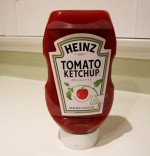
We started looking at a Heinz ketchup bottle on our table, noticing surface features, shape, size, colors, label design, a ridge on the bottom, materials, any detail.
“Of course, this isn’t about details,” I reminded Greg. “It’s about what’s there.”
“But you’ve always said ‘what’s there’ is surface features.”
“Sure, but what’s a surface feature? It’s what my mind selects to notice. Let’s see what happens when we back off now and allow ourselves to and take another look at the whole thing. It’s not the same ketchup bottle that was here when we came in. If we keep looking at it, it will become unique in all the world, the way the Little Prince’s rose was. That’s how we influence the world, one way that we do. We take in sensory information and mingle that with what’s already in the reality program in our brains, and send out a revised sensory beam with which we now envelope the bottle.”
I went to the restroom, and when I came back, Greg was smiling.
“While you were gone, I tried the surface features game on that wall behind you. Amazing!”
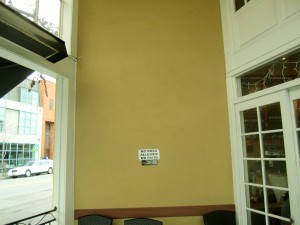
It was a pale yellow stucco wall, and the sun passing through window panels behind Greg had cast a cross-hatch of pale shadows on that surface. [Today, I went by Crepvine and photographed the wall to include with this post. But today it was cloudy out, and there were no patterns on the wall. So the question is, Was Greg’s wall a better one for practicing the surface-features game or was this one in the photo above?]
“But instead of making the usual observations,” he continued, “I looked at shapes, color variations, textures, that long black thin line two-thirds up. All of a sudden the game stopped, and I was simply there, beyond words! I got chills up my back. It was there all at once, beyond interpretation or impression, as if it was presenting itself to me.”
“And just think,” I said, “every speck of fly dirt we encounter has this potential. It’s so powerful, like the energy cooped up in an atom. And all it took to let it explode was your attention. Greg, you’re a nuclear physicist!
“Maybe we ought to get a saw and cart the whole wall off to the San Francisco Museum of Modern Art, put a frame around it, maybe, just to make sure people paid proper attention to it.”
That got us thinking about the objets trouvés project we used to do in our classes (my post February 2, 2013).
“Actually, Greg, now that I think about it,” I went on, “we wouldn’t need to haul the yellow stucco wall off to a museum. We could leave it right here and make up a plaque, maybe bronze: ‘Wall, Sun Shadows on Yellow Stucco – Gregory Maier, January 6, 2006. NFS’ Come to think of it, an enterprising Christo type could go around Oakland putting up little plaques on everything. ‘Ketchup Bottle’, Emily Heilman, 1/23/06; ‘Chewing Gum on Sidewalk’, Tony Kane, 1/25/06′, and so on”
“Yeah, but in about one day, the whole project would become the latest craze, and people would stop looking again.”
“I suppose so. To stay alive, you can’t skate by on yesterday’s findings. What’s up right now, that’s what needs tending to, isn’t it?”
Before I headed back to San Francisco, Greg had a parting shot. “You know, Clark, seeing this way isn’t free. You have to pay. You have pay attention.”
***
On BART I thought back over our lunch and remembered an experience Paul Wienpahl had written about in Zen Diary . On a sabbatical, Wienpahl had been studying zen Buddhism in Japan, and for several days he had been trying to grasp how a person and some object could be one and the same. That just did not fit his training as a scientist from a Western culture. I looked up the passage when I got back to my desk :
Walking back I again have the experience of identification with the world. There is nothing to think about now. However, this time the identification is with a bamboo tree. Standing before it, I first have a brotherly feeling for it. Then I feel that it and I are one. I merge with it. It becomes conscious.

The Assignment: What The Boss Wants — What You Want
“Read Chapter 2”, “Read today’s emails”.
If you have any self-regard, you would not start in at the top and read every word. But lots of students and dutiful employees do. If you’re running the show, though, for your own purposes, the approach is quite different.
First, find out for sure what the teacher or boss wants, not what they say they want, but what they really want. Often, they aren’t clear-headed enough themselves to know. But if you observe what what they actually zero in on and what they choose to talk about (or test on), then you begin to catch on to what the assignment really is. Once you know that, intelligent reading will cut wasted time dramatically.
Then, use the Mess-Around method (November 11, 2012) to dig out what they want. BFAR — Browse, Focus, Absorb, Reinforce — (November 23, 2012) will fall naturally into the process.
Finally, decide what’s in it for you. What do you want for yourself? That’s pretty much a separate matter in most school- and work situations. Hint: You love the realms of gold. You can convert any situation so that you can have an exciting and joy filled time of it.
Anything wrong with the above line of reasoning?

Here’s an idea for your weekend:
Give the slow-walk I recommended in my January 15th post another go.
This time while walking bring back something you probably would not notice if you were actually going somewhere instead of just . . . walk . . . ing, preferably something least likely.
(Of course, this won’t work with little kids. To them, everything is wonderful.)
Now figure out some way somehow or other to present that object so that it can’t help but be paid attention.
Ordinary Reality Illuminated
One of my students brought back that little piece of bark in the picture above, fashioned into a pendant. I’ve kept it around for decades, but the students were so good at it we took over some walls in the campus science museum put on an exhibition.
Objects found — objects of art.
I think you will agree that all it takes to convert the ordinary into a rain-glazed red wheelbarrow is your beam of attention.
Right?
Let my know what you think.
If you are walking around
the planet
and see
what you are looking at
you will have discovered
a poem.

Use the the same strategy for text assignments and bureaucratic verbiage as for reading anything intelligently (laid out my 11/23/12 post): Mess around, which evolves into BFAR – Browse, Focus, Absorb, Reinforce. Looking-before-leaping, is almost always a good idea.
Here are two more ways to take charge. Taking charge, of course, is what the Mess-Around method really is. After all, unless you are some sort of a wimp, you are the one who decides what you want out of that page of print or from that long weblog. No sane person starts in reading word for word, line by line. Right? How are you going to find gold if you don’t even know that’s what you’re after?
1. Read Backwards
If you have far less time than you think you need, try starting at the back of the chapter or article . . . or whatever. If I were you, I’d leaf through fast anyway just for an overview, but then take a look at the last paragraph or so. The gist is often bunched in the summary. If you’re in a really big hurry, that might give you at least an overview, some idea of what the piece is all about. Better than nothing, for sure. Busy professionals routinely look through piles of stuff one their desks that way. Then they decide for themselves how much time they give to a piece.
And if you keep on browsing toward the front, skipping, skimming, you may feel pretty comfortable half way through.
Reading backwards isn’t all that nutty:Reading backwards has to be active reading. It forces you to pay attention; you can’t do this passively. You have to translate it into your own understanding as you go. A lot of what’s in that article may be stuff you already know, so what’s new? And do you care? You decide what you want.
This kind of messing around is active processing of information. The point is, if you have some system, it will work much better than if you don’t. I’d bet you already know that. It’s your show; you’re not dominated by someone who decided to write a book – who may or may not have something to say. You are in this for yourself, not for your teacher or your boss.
You are free to get meaning any way you can dream up.
2. Read the Bold Print and Look at Pictures
If you have your wits about you, this might work. Certain books don’t deserve more. If that’s the case, this much preparation may be all you need. Check out the bold print and pictures.
This approach will give you the pattern of the chapter and the author’s main points. (See? That’s one of my main points, so it’s in bold print.) You will also learn whether you may already have enough background to supply your own supporting evidence. No one comes totally empty-handed to any new experience, so put your own knowledge into the mix. If the main ideas make sense to you, you may not need the author’s explanation.
But such an overview also reveals how the ideas are structured and how they are related. So, you are forming in your mind the pattern you’ll need for storing what you find. That’s a memory device. You’re not making a meaningless pile of trivia.
Meanwhile, you can’t help but begin to connect the ideas you find in the print and ideas of your own. That’s you the mind works. Next time you try this out, watch your mind at work.
Finally, if you still have some time, a bold-print-and-picture approach will have revealed what’s still fuzzy and just where it is. Now you can go back and mess around with that.
Make sense?
Emily:“Does anyone ever realize life every, every minute?”
Stage Manager: “No. The saints and poets maybe. They do some.”
– Our Town

Rolling Down Geary
The first thing I need to do
when I wake up
is make sure
the music’s sweetly humming
on the nerve endings.
Now I’m ready for the 38 MUNI
and half an hour for catching glimpses
of the poem of creation.
With all the seats filled
and holograms standing,
it’s easy.
There we are
rolling along.
I fiddle with these baubles.
Then,
first stop, the ordinary,
then, second stop, and intense vision
of the facts,
then, with rare good luck,
the supra-ordinary, the realms
of gold.
Then, I’m home again.
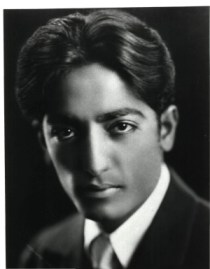

One morning in around 1610 Jakob Boehme saw sunlight reflected on a pewter bowl and wrote that he had seen all heaven. In the early twentieth century, a high school kid living in Hollywood was invited by his family’s friend Krishnamurti to attend a retreat in Holland. I included his account of his experience and its effect on his life in a chapter in the manuscript of The Realms of Gold. Notice the similarity to Jane Goodall’s in Gombe and Notre Dame Cathedral I posted January 21. Here’s Sidney Field’s story:
Hawks and Sunflowers
Just after graduation from Hollywood High, at the invitation of his family’s friend, Jiddu Krishnamurti, the Indian philosopher, teacher and mystic, Sidney Field had traveled to Camp Ommen in Holland and to a pre-Camp gathering at Eerde, an elegant estate that had been set aside for Krishnamurti’s use in his teaching. Sidney was seated with a number of other guests on a Persian rug in the large library where Krishnamurti was giving a short welcoming talk.
At some point during the talk, something extraordinary happened to me. For no apparent reason I experienced a sudden outburst of intense joy in the region of the heart. It went on and on in increasingly strong rhythmic waves, until I thought I would have to open my mouth and shout for joy. . . . It was an experience that practically lifted me out of my body, something I had never felt before or thought I could ever feel.
Later, hoping to “preserve the fragrance of that indescribable moment as long as possible,” Sidney sat by himself under a shady elm and felt the force of the experience gradually quiet down and leave a “ great sense of peace and up-welling love.” Even though the intensity of the experience receded as the days passed, it informed all the years of his life. Ten years his senior, Krishnamurti remained his friend and spiritual touchstone till Krishnamurti’s death sixty years later.
Traveling in the Realms of Gold
On his way back to California from Europe Sidney had his second experience of ‘the miracle of Eerde.’ He had left Chicago on the Sunset Limited feeling depressed and discouraged at the prospect of returning to the ordinary reality of American life. He was standing on the open section of the observation car, thinking of nothing in particular, looking out at the hot and dusty desert, when
a giant sunflower growing beside the railroad tracks, a few inches from destruction, brushed rapidly past my face, incredibly close, its golden face momentarily shutting out the world. Like a coiled spring, the great joy, self-exiled these past few weeks, leaped out of me, as if to greet the daring flower beside the tracks – a joyous sunburst to a glorious sunflower!
When he looked back into the observation car, the world of a moment before was transfigured. The same dull, fat people were still there, but touched with the laser beam of clarity, all as marvelous as the golden face that had momentarily stripped away the sackcloth of ordinary reality. It had come totally unexpected and uninvited.
The preface to Sidney Field’s book KRISHNAMURTI The Reluctant Messiah in which he records these experiences begins with a line from Yeats: “One has had a vision; one wants another; that is all.” Back home and caught up in the family business, it seemed to Sidney the joy that had so overwhelmed him might recede over the years and become a fading memory. But in Nichols Canyon in the hills just above his home, he found a way to be at peace with himself. He would sit by the hour absorbing sounds and sights all around him with an acuity he had never before enjoyed. One day, lying on his back and looking up at the sky, he became absorbed with a hawk circling high above, its flight “a thing of sheer beauty.”
All at once the wondrous joy seized my heart. It had returned! I was ecstatic. I let it carry me higher and higher . . . in rhythmic waves of joy. But the “altitude” and intensity of it held me back somewhat. I knew I was dealing with a tremendous force entirely new in my life, and although I realized I must eventually let go completely, something kept me from surrendering completely to it.
After that, the experience came to him regularly, a joyous presence he cherished but which was sometimes so powerful he would pull back and let it unwind at a more bearable tempo. One evening on his way home from the hills, he writes, “I was so filled with the shining joy that everything my eyes met, whether a human being, an animal, a tree or a rock, called forth an outpouring of love.” His body felt a vitality, harmony and balance he had never known before. His mind was tranquil and crystal clear. When he got home, a friend of the family exclaimed, “Look at Sidney! Look at his face. He must be in love!” She had been right, he wrote, but it was not the kind of love she was thinking of.
Even so, there is a line between that-which-is (love) and ordinary reality beyond which a rare few venture. Mark Bittner [ Who wrote of his own epiphany in The Wild Parrots of Telegraph Hill, and whose experience is described earlier in the manuscript for Realms of Gold] had stepped back the evening Dogen, the cherry-headed parrot, pulled herself onto his chest and looked into his eyes. Something had kept Sidney Field from going all the way through the magic opening. He knew if we do not pass through without hesitation the opening will probably close. That-which-is demands all or nothing.


One morning I saw a girl walking along Sutter Street in San Francisco. She was talking on her phone. I blinked and when I looked again, she was a bunched up bundle of golden sunlight. I blinked again and she was walking along as if no miracle had occurred. I don’t think she realized that she is an atomic furnace of fiery energy. She probably didn’t notice a ball of sunlight floating behind her wearing a watch cap, another one in a black coat headed into What-a-Grind, four white ones lined up outside, and all sorts of other bundles of sunshine all around her. She probably thought it was just a street in San Francisco.
What do you think?
Sailing in the Sea of Intelligence
I think
Of how flocks can fly
as if they were one being
Of how the brain can fix itself
and even assign
new jobs –
oh, and spiders, too.
Of how I can make things move
by thinking,
of how my heart beats
anyhow
Of how the cat knows
an earthquake’s coming
Of the simultaneity
of distant events
Of how
trees and refrigerators
and viruses and quartz crystals
and sub-atomic particles
can act intelligently
Of how the universe
is music
Of how you and I
and the spider
are the concert master
Of how thinking of these things
is to love again.
 Realms of Gold