Lighting Up the Realms of Gold: Charles Demuth and William Carlos Williams

What’s  There

500px-Demuth_Charles_I_Saw_the_Figure_5_in_Gold_1928It’s the time you spend on your rose.

–  The Little Prince

 
Generally, by the time you are real
most of your hair has been loved off.
– The Velveteen Rabbit


Surface-Features Opportunity

Here’s a chance to sharpen up your vision of the facts.

  • Take a good look at this painting. Give yourself at least twenty minutes.  Just pay attention to any detail actually there on the surface, shapes, sizes, colors, words – any detail no matter how small.
  • Try not to give meaning to the painting while you’re taking this surface-features excursion.  Also,  do as little evaluation, judging, critiquing, as yo can.
  • Keep doing this till you run out of details.  You won’t!  But you will get the hang of it in twenty minutes.
  • Now, step back and look at the whole painting again.  Did you brighten it up?  Did you love off some of its hair?

My Commentary follows.

However –

You will spoil your fun if you read my commentary without doing the surface-features game first. 


When my students and I used to do this together, we’d go around and ask each person to point out something in the painting that hadn’t already been noted.  We kept on for several rounds.

What happened was that each time a detail was pointed out it was as if that bit of the painting had a spot light on it.


The painting got more and more vivid as we went along.


By the time we stepped back and looked at the painting whole, it was a new painting, brilliantly visible.

The same painting, but seen intensely.

And no one even felt like criticizing it. We had entered the realms of gold.

William Carlos Williams and the Figure 5

After reading a poem by his friend William Carlos Williams, Charles Demuth did this painting, I Saw the Figure 5 in Gold, in 1928 — it hangs in the Museum of Modern Art in New York. Here’s the poem:


The Great Figure

Among the rain

and lights

I saw the figure 5

in gold

on a red

firetruck

moving

tense

unheeded

to gong clangs

siren howls

and wheels rumbling

through the dark city.

Art Lesson

Notice how the words can illuminate the painting

         and

how the painting can illuminate the words.

Memorizing School-Game Trivia

YOUR BRILLIANT MIND

Get Your A Book

OLYMPUS DIGITAL CAMERA


Memory Inventory

Mark only the ideas you agree with.  Then read the commentary that follows.

☐   1.  Intelligent people have better memories.
☐   2.  Memorizing requires effort and discipline.
☐   3.  Memorizing is a logical, step-by-step process.
☐   4.  Grownups have better memory techniques than children.
☐  5.  Memorizing must be conscious and purposeful.
☐   6.  Students are not graded on their memory skills.
☐   7.  The more time spent, the more remembered.
☐   8.   Remembering something requires saying it over and over.
☐   9.  Memorizing should be vigorous and aggressive, not laid back and random.
☐ 10.  Some subjects are harder to memorize than others.

Commentary

If you took my little “test” on how good you are at the school game (February 6, 2013), you know the test-maker (me) thinks none of those ten ideas is true.  In the school game, you wouldn’t check any, and you would get a good grade.  That’s how the game is played. Your views are beside the point.

The truth is, though,  that acting as if those statements in the inventory above are true will only interfere with your efforts.

Once you remember how good you are at it already, memorizing can actually be fun.  Here are some reminders.

1.  A typical human brain stores billions of bits of information – effortlessly.  The bits of extra data a flashy memory entertainer can display are insignificant compared to what all your brain – any brain – contains.

Everyone’s memory bank is about the same size.

You’ve already stored tremendous masses of data – without breaking a sweat.  If you smoothed out all the wrinkles in your wetware, you would have a three-foot-square grid, infinitely better than the smartest microchip.  You are smart, far too smart to be floored by the trivia you are asked to store while in school, most of which will be useless once you leave school, most of which you will have forgotten anyway.

Retrieving

You are also brilliant at retrieving anything of value that you’ve stored in your nervous system.  Just think what all was involved in your reading of the previous sentence.  (Reading researchers still can’t quite figure it out.)  Think what’s involved in picking up a pencil, blinking your eye.

What doubts we might have about our retaining and recalling stuff more than likely were acquired in the unnatural learning situations commonly found in schools.  Use your natural learning skills and you will be able to learn any school subject the way you’ve learned everything else in life.

Even people who are “intelligent” don’t have better memories.  

2.  Where would you be if you had had to “memorize” the more than 150,000 words stored up in your brain?  Did you sit down with lists, break a sweat, have nightmares about it?  You didn’t get up at 5 a. m. to study and lose valuable sleep poring over mountains of data.  Whatever you were doing, those methods were far superior to the puritan methods commonly pushed in schools.

Memorizing is a natural biological process – if not interfered with.

No one knows how you go about it, but the non-conscious part of your mind does know and does it routinely, – unless you or some well-meaning teachers gum up the works.    We do know some ways to set the stage for natural learning.

You can have a good time doing schoolwork and actually feel refreshed after a couple of hours at your desk.

3.  We have no certainty of what goes on during learning or memorizing, but whatever it is, learning and memorizing  seems to be anything but logical and systematic.  It doesn’t care if school keeps or not.

The process appears to start anywhere at all, go off on tangents, move back and forth between parts and the whole picture.  At some point, it sends a completed printout to our conscious minds so that we can describe in words or music or pictures or sculpture what we already know.

Our conscious mind performs valuable services.  It’s our automatic talking machine.  We can use it to deliberately set motion the non-conscious processes that figure things out.  We can write down the results.

4.  Kids have complete confidence in their wetware and don’t interfere with the excellent learning machinery they were born with.  Most adults, unless they’ve remembered how it’s really done, try to do it all with their conscious minds. Kids learn automatically.  What they learn is guided by their spirits, so they probably don’t know consciously how they pull it off.  They just do it, like breathing.

What grownups who have figured it out can do is set the process in motion –  and then relax and let it happen.

5.  Your non-conscious mind will let your conscious mind know what it ought to be doing.  And that is NOT a very orderly process.  There may be periods of intense scrutiny with abrupt changes of direction, crazy word games, going of on a side path, circling, resting, doing the dishes, sleeping on it.

If you trust your wetware, the way a child does, you will always do the right thing

 Believe it or not – and you will believe it once you catch on – all this messiness is the most efficient way to learn.  And learning  is a much better word for what you are up to than the word memorizing is.

6.  Oh, yes, schools do indeed reward good memory with higher grades.

 In fact, memory is the one thing that is graded. 

 Grading for most courses is based on tests.  Even short-answer tests and essays reward remembering and recalling data.  Even teachers who value understanding and growth and change don’t know how discover it.  So they resort to checking for quantities of stored data.

The greatest concern most students have is whether they will be able to remember data for a test.
The better you get at it – mostly the vocabulary of the subject –  the better your grades.  Of course, this knack has very little use off campus.  Hence, the phenomenal success of trivia games.

Remembering is the essence of the school game.  

Once you know that, it’s easy to develop the skill.  In later posts, I’ll describe some of the tricks of the trade, techniques that are easy to apply.

7.  Studying itself is no guarantee that you will remember.

 How you use your time is much more relevant. 

 If you use your study time intelligently, you can cut time spent in half – or less.  In later posts I’ll describe some ways to set up pleasant and productive study time.

Keep in mind, memory is a by-product of learning.

Understanding how we learn and remember will reduce considerably the slave labor of grinding away at books.  You will spend less and less time trying to remember, yet you will be able to recall anything you want.

8.  Rote memory, repeating something over and over,  is the poorest way to commit something to memory.

It doesn’t take long to turn what you are repeating into meaningless gibberish, and the mind simply won’t play that game.  Right?

If you are asked to store trivia, there are pleasant, intelligent ways of doing it – but not as a mantra.  

9.  We cannot bully our minds.  

If you try to brow-beat your conscious mind into doing the learning (remembering), your spirit will not allow it.   All parts of the brain must be in harmony, if you want it to work.  Sitting up straight, beating our breast and frowning will shut the whole thing down.

I remember a colleague wondered why her quiet 8:00 section scored higher on her tests than her energetic 11:00 of the same course.  It’s likely students in  the early class were closer to their natural learning state than were the more intense students.

When the mind has room to play, it in its optimum learning mode.  Not surprisingly, the setting resembles a sandbox.

10.  Getting the hang of chemistry is no different from getting the hang of driving or mixing cocktails or sorting the mail.

 There are no difficult subjects, only areas of experience more distant from our daily environment than the “easy” subjects.

If one plays around with a new subject the way a child does with new experiences, in due time the code will come into focus, and the new field will be just as easy as anything else.

The key is to know how your brain works, to relax and to allow it to do its job.

Workplace Realms of Gold: Illuminating the Moment

How Your Spirit fills the Space

Sunlight on Flowers


The other day, I picked a couple of blossoms and some leaves along the lagoon where I walk sometimes, and when I got home we put them in a slate bud vase on our dining room table.  The sunlight and shadows reminded me of Boehme’s sunlight on a pewter bowl and of something a student had written long after our classes together.

I used to tell my students I hoped they would never have to ‘work’. Some of my colleagues considered such talk irresponsible.  But my students understood that I hoped they would find their bliss and follow it and that it was not so much what you did everyday but how your spirit filled that space.  Carol had done the brave thing and come back to college, not so much to get ready for a good job as to see if there might not be more to the moment than sweat.  I was glad to see some ten years later how things were going with her:

Liquid Amber —  By Carol Stout

I brought red, purple, orange and green fall leaves to someone longer than ten years ago.  I walked into his office as he got to his feet, smiling.  Did he have something I could put it in?

 
Earlier that morning, I hadn’t been able to resist picking them from the trees in my back yard, magnificent from my kitchen window, their deep and fiery hues.  I’d made a bouquet for the kitchen, but had captured more wonder than could be contained in one vase.  OK, give someone else a close-up look at a bit of the everyday magic.  I’ll take them to the college and give them to my English teacher.  I knew he would be the right person.
He liked making ordinary things  ‘extra-ordinary;’ and many of us would make up excuses to drop by.  We always left feeling better.  I read years later that someone had said that of T. S. Eliot.  I knew what that writer meant. Lots of us became addicted to his capacity to illuminate ordinary moments.   We were  learning how to do that for ourselves, how to see every day as an adventure, to watch for the surprises that would unfold this day.
He reached into a bottom desk drawer and pulled out an old Ball glass canning jar. New leaves, old jar. A small moment?

 
In this present time, where I work, we like to take turns bringing goodies for celebrations  ‒  or for no special reason at all  ‒  we just like being accomplices in the criminal activity of wonder.  So, it’s  October and the trees are just now changing in the Bay Area.  I am on my break walking along a path near our office slow enough to soak up my surroundings.   At that pace noticing the blaze of leaves can’t be ignored.  A many-hued branch of liquid amber reaches out, beckoning me closer.  It is just the shape and size for a vase.
“Well, let’s bring a little something from the outside in,” I think.  I’ll gather a few stems of the Toyon bush to go with the branch of liquid amber.  The toyon is loaded with berries just beginning to turn red.  They go well together, I decide, holding my work of art at the end of my outstretched arm in it’s vase of a hand.

 
In the lunchroom, I search for a suitable container.  My creation needs  properly framed.  And there, where it had been for weeks, without so much as a tiny jog to my memory, sits a Ball canning jar, complete with snap-on lid.  It fairly screams, “Use me, use me!”  Time and space evaporate as the rush of images and feelings of that other present, those other leaves, and that other jar transport me.

 
And I remember, too, how long ago, I noticed days later that the water was all gone in that other Ball jar.  The leaves were still colorful, and they had the added charm of being slightly curly, as if hooking a finger the viewer’s way, “Look at me, look at me!  I’m older and more wrinkly now, but I have a different beauty.”  But that day I said to my friend, “Oh, the leaves are dried out!”  I reached to take them off his desk, but he stopped me, putting into words the very thoughts I had just had.

 
“Well, yes, they have dried out, but   I like seeing them when I come in in the morning.”  Once again I left his office feeling good.

 
Years ago I brought red, purple, orange, green fall leaves to someone. I was an adult student returning to college, nervous about being back taking classes.  As I reflect on it , such  moments give us back the  world, the world of wonder at our finger tips. And  what I’m thinking now, this present moment, is that small moments enrich our lives, not just for that time and place but for moments yet to come, perhaps in some lunch room many years removed, yet richly connected to that ordinary moment.

A LOOK AT THE SCHOOL GAME: How Good Are You At It?

Get Your A Book

A Self-Test
Here’s a little self-test you can try out.  If you get 100 %, you should share your expertise with everyone you know!


Mark only the statements you agree with. Then read the commentary that follows.

☐  1.  We learn what is taught.
☐  2.  Classrooms are good places to learn.  Traditional classrooms are the best places               to learn.
☐  3. Education involves lesson plans, grades, curriculum materials, textbooks, assign-              ments,  group-paced activities, prerequisites, competition.
☐  4.  Knowing a subject well insures high grades.
☐   5.  High-school grades, college grades and scores on the SAT are good indicators                of adult  success as measured by satisfaction in life, leadership, self-acceptance,              mention in Who’s Who.
☐  6.  A teacher is someone who knows.
☐  7.  Learning is logical.  Learning is sequential.
☐  8. More than one person can be taught the same thing at the same time.
☐  9.  Learning is gathering and storing information.
☐ 10. Lectures and textbooks are the best means of transmitting information.
☐ 11. Schools provide tools for school success.
☐ 12. Schools provide tools for life success.

  Commentary on the School-Game Test

First off, if you’re good at test-taking, you will have figured out the “wanted” answers right away or certainly after a quick overview.  The test-maker (yours truly) gives away his biases early on, and once you see that, you know exactly how to ace the test.   In most tests, what you really think is beside the point.  The game is to give the response the test-maker wants.  The game is rigged.

All of the statements in the little “test” above are false.  If you do think some of the statements are true, here’s some commentary in would be in your interest to think about.

1.  What’s taught is NOT what is learned.  We learn what we do.

                                            Learning is growth and change.  

When an organism changes, when it can do something it couldn’t do before, that is learning.  Unless there is growth and change, nothing whatsoever has been learned.

In classrooms, we do learn to sit in rows or circles (or learn to rebel against this).  We learn (or don’t learn) punctuality, submission  to authority (or rebel against it), passivity, inattentiveness, self-doubt, fear, boredom.  You can make your own list.

2. . . . good places to learn things . . .?


Margaret Meade wrote that her grandmother wanted her to have an education, so she kept her out of school.


Jane Goodall knew where to go for an education.


From the time you were born till now, how much of your learning actually occurred in school?  Miracle of miracles,  we all, D students included, somehow or other have learned billions of things – where the sun appears each dawn and how it feels, the feeling of love, how to walk on two legs, how to tie shoes, how to go to the toilet.  And on and on.  How much of the total can be traced to schooling?  An infinitesimal speck. Even the “facts” have to be adjusted as we go along.

If learning to walk or to talk required schooling, most of us would still be in remedial classes.

If we are not interfered with, we learn effortlessly.  To master a school subject, find out how you do learn.  Then do it on purpose.


3.  . . . lesson plans, grades, curriculum materials, textbooks   . . . ?

Actually, there is NO connection between all that folderol and learning.  In fact, all that huffing and puffing is counterproductive.  The mind hates straitjackets and refuses to respond.

Regimented curricula make school subjects needlessly difficult.

4.  Subject mastery equals high grades?

If two people know the subject well but only one knows the school game, guess who gets the higher grade.

Mastering the school game is the best preparation for any school subject.

Understanding, seeing, growing, changing are a joy.  But grades are not awarded for them.  Grading has its own rules and must never be confused with education.

The only thing grades show is skill at getting grades.

A student could get good at algebra or physics,  but that facility is separate from getting grades.  You already knew that!

5.  Grades and life success?

Grades do reveal grade-getting skills, and SATs call for similar skills – all within the closed system.

Grades and tests have NO significance once we step off campus.

Right?

6. . . . someone who knows . . . /

     A teacher is someone who knows how to learn and is willing to do it in public.

A teacher is someone who got there before you did.  That person learns (practices the process) right out in front of everyone, warts and all, and then you can catch on.  “So THAT’S how it’s done!”

 
What with the information explosion, it hopeless for a teacher to be a fact pusher.

7.   . . . logical? . . .sequential . . . ?

     Logic and sequence come AFTER we have learned something.

A part of the brain, the non-conscious part, is capable of making sense out of information that comes in haphazardly, any which way.  Since there is no way to get in there and see how this works, institutions like schools act as if that kind of mental activity doesn’t exist.  But that’s where the action is.  Only a small part of figuring things out is conscious.  We use language to nail down what we have already discovered.

     When the conscious and non-conscious work together, schooling is actually fun.

8. Individuals in groups learn the same thing at the same time?

In any group, learning is going on constantly, but what’s learned is NEVER what a teacher has in mind.  Not even one listener will be learning what the teacher thinks is being taught.  That’s the biological nature of unique organisms.


Each brain contains a unique program that picks and chooses among available data and puts bits and pieces together in its own way.


9. , , , gathering and storing . . .

Google gathers and stores.  Wikipedia does that.  Libraries used to.  Like squirrels, people who squirrel away lots and lots of facts – with very short shelf life – will soon forget 90 percent of them.

Information is learned when it is chewed and digested.  We know it’s been a good meal when we have grown and changed.

Hardly any time in schools is spent on getting new ideas onto the nerve endings.

10. Lecturing is NOT teaching.

The mind cannot learn (process) while it is being talked at, and it can’t be fooled by stultifying prose.  It simply turns off.  It’s true that some lectures are beautiful and brilliant.  Some may be awful but presented by poetic and brilliant people.  I would go out of my way to hear either kind of speech.  But the learning would have to take place afterward – by me.  A student who tries to learn during a lecture will drive the speaker nuts.  It’s bad etiquette to try to learn while being spoken to.

Lecturing and teaching are separate activities.

11. . . . tools for school success . . .?

School success depends on memorizing, taking tests, getting the gist of  textbooks, doing assignments, taking classes .

If you want to play the school game intelligently, you need to get good at all those areas.

12. . . . life success . . . ?

There is NO relation between schooling and living a successful life. 

The kid who manages his or her own paper route or has a lawn-mowing or  housecleaning service or becomes absorbed in a meaningful hobby is far more likely to lead a fulfilling adult life than the competitive grade-getter.

Even sitting down to dinner with your family has more to do with a rich, full life than anything that happens in classrooms.

Toward the Realms of Gold

Stopping Time

It doesn’t matter what train
we catch –

 OLYMPUS DIGITAL CAMERA


religion, science, mathematics,
poetry, music, painting,
baking, grape stomping —

 or walking along a mountain
path.

We look, we look,
and suddenly
we see.

Everything stops;
we come to rest
in eternity,
a timeless
now.

Then we can resume
gardening,
watching people on the street,
eating chocolate eclairs –
often in wonder.

“One has a vision;
one wants another.”

Surface Features Alchemy: Yellow Stucco Wall

Yellow Wall

My hut, in springtime —
there is nothing in it. Oh!
there is Everything!
–  Sodo, (1642-1716)


Walking around the planet at half-speed and paying attention to surface features requires brushing up from time to time – unless you are a very old woman walking by the duck pond, or a little kid anywhere at all.  Here’s a reminder a former student and I had when we met for lunch years later.

We were at Crepvine, a café near the BART station in Oakland,   reminiscing about the surface-features game we used to play in our classes some fifteen years earlier and recalling what happens when we give attention to what is right before our eyes, looking at details  and avoiding interpreting as much as possible (described in my May 5, 2012 post).  Greg was married with two cute little kids by then, but neither of us was ready to put away childish things.

Heinz Bottle

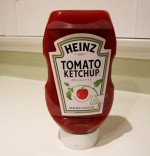
We started looking at a Heinz  ketchup bottle on our table, noticing surface features, shape, size, colors, label design, a ridge on the bottom, materials, any detail.

“Of course, this isn’t about details,” I reminded Greg.  “It’s about what’s there.”

“But you’ve always said ‘what’s there’ is surface features.”

“Sure, but what’s a surface feature?  It’s what my mind selects to notice.  Let’s see what happens when we back off now and allow ourselves to and take another look at the whole thing.  It’s not the same ketchup bottle that was here when we came in.  If we keep looking at it, it will become unique in all the world, the way the Little Prince’s rose was. That’s how we influence the world, one way that we do.  We take in sensory information and mingle that with what’s already in the reality program in our brains, and send out a revised sensory beam with which we now envelope the bottle.”

I went to the restroom, and when I came back, Greg was smiling.

“While you were gone, I tried the surface features game on that wall behind you.  Amazing!”

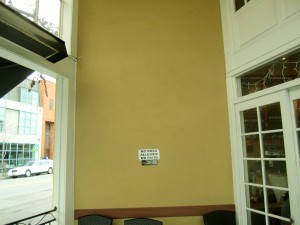
It was a pale yellow stucco wall, and the sun passing through window panels behind Greg had cast a cross-hatch of pale shadows on that surface. [Today, I went by Crepvine and photographed the wall to include with this post.  But today it was cloudy out, and there were no patterns on the wall.  So the question is, Was Greg’s wall a better one for practicing the surface-features game or was this one in the photo above?]

“But instead of making the usual observations,” he continued, “I looked at shapes, color variations, textures, that long black thin line two-thirds up.  All of a sudden the game stopped, and I was simply there, beyond words!  I got chills up my back.  It was there all at once, beyond interpretation or impression, as if it was presenting itself to me.”

“And just think,” I said, “every speck of fly dirt we encounter has this potential.  It’s so powerful, like the energy cooped up in an atom.  And all it took to let it explode was your attention.  Greg, you’re a nuclear physicist!

“Maybe we ought to get a saw and cart the whole wall off to the San Francisco Museum of Modern Art, put a frame around it, maybe, just to make sure people paid proper attention to it.”

That got us thinking about the objets trouvés project  we used to do in our classes (my post February 2, 2013).
“Actually, Greg, now that I think about it,” I went on, “we wouldn’t  need to haul the yellow stucco wall off  to a museum.  We could leave it right here and make up a plaque, maybe bronze: ‘Wall, Sun Shadows on Yellow Stucco – Gregory Maier, January 6, 2006. NFS’ Come to think of it, an enterprising Christo type could go around Oakland putting up little plaques on everything.  ‘Ketchup Bottle’, Emily Heilman, 1/23/06; ‘Chewing Gum on Sidewalk’, Tony Kane, 1/25/06′, and so on”

“Yeah, but in about one day, the whole project would become the latest craze, and people would stop looking again.”

“I suppose so.  To stay alive, you can’t skate by on yesterday’s findings.  What’s up right now, that’s what needs tending to, isn’t it?”

Before I headed back to San Francisco, Greg had a parting shot.  “You know, Clark, seeing this way isn’t free.  You have to pay.  You have pay attention.”

***

On BART I thought back over our lunch and remembered an experience  Paul Wienpahl had written about in Zen Diary . On a sabbatical, Wienpahl had been studying zen Buddhism in Japan, and for several days he had been trying to grasp how a person and some object could be one and the same.  That just did not fit his training as a scientist from a Western culture.  I looked up the passage when I got back to my desk :

Walking back I again have the experience of identification with the world.  There is nothing to think about now.  However, this time the identification is with a bamboo tree.  Standing before it, I first have a brotherly feeling for it.  Then I feel that it and I are one.  I merge with it.  It becomes conscious.

Intelligent Reading II: Textbooks and Other Dull Stuff 2

Get Your A Book

The Assignment:  What The Boss Wants — What You Want

“Read Chapter 2”, “Read today’s emails”.

If you have any self-regard, you would not start in at the top and read every word.  But lots of students and dutiful employees do.  If you’re running the show, though, for your own purposes, the approach is quite different.

First, find out for sure what the teacher or boss wants, not what they say they want, but what they really want.  Often, they aren’t clear-headed enough themselves to know.  But if you observe what what they actually zero in on and what they choose to talk about (or test on), then you begin to catch on to what the assignment really is.  Once you know that, intelligent reading will cut wasted time dramatically.

Then, use the Mess-Around method (November 11, 2012) to dig out what they want.  BFAR — Browse, Focus, Absorb, Reinforce — (November 23, 2012) will fall naturally into the process.

Finally, decide what’s in it for you.  What do you want for yourself?  That’s pretty much a separate matter in most school- and work situations.  Hint:  You love the realms of gold.  You can convert any situation so that you can  have an exciting and joy filled time of it.

Anything wrong with the above line of reasoning?


Slow-Walking the Neighborhood: Found Object into Objet d’Art

found object

Here’s an idea for your weekend:

Give the slow-walk I recommended in my January 15th post another go.

This time while walking bring back something you probably would not notice if you were actually going somewhere instead of just  . . .    walk    . . .    ing, preferably something least likely.

(Of course, this won’t work with little kids.  To them, everything is wonderful.)

Now figure out some way somehow or other  to present that object so that it can’t help but be paid attention.

Ordinary Reality Illuminated

One of my students brought back that little piece of bark in the picture above, fashioned into a pendant.  I’ve kept it around for decades, but the students were so good at it we took over some walls in the campus science museum put on an exhibition.

Objects found —  objects of art.

I think you will agree that all it takes to convert the ordinary into a rain-glazed red wheelbarrow is your beam of attention.

Right?

Let my know what you think.

If you are walking around

the planet

and see

what you are looking at

you will have discovered

a poem.


Intelligent Reading II: Textbooks and Other Dull Stuff

Get Your A Book

Use the the same strategy  for text assignments and bureaucratic verbiage as for reading anything intelligently (laid out my 11/23/12 post):  Mess around, which evolves into BFAR – Browse, Focus, Absorb, Reinforce.  Looking-before-leaping, is almost always a good idea.

Here are two more ways to take charge. Taking charge, of course, is what the Mess-Around method really is.  After all, unless you are some sort of a wimp, you are the one who decides what you want out of that page of print or from that long weblog.   No sane person starts in reading word for word, line by line.  Right?  How are you going to find gold if you don’t even know that’s what you’re after?

1. Read Backwards

If you have far less time than you think you need, try starting at the back of the chapter or article . . .  or whatever.  If I were you, I’d leaf through fast anyway just for an overview, but then take a look at the last paragraph or so.  The gist is often bunched in the summary. If you’re in a really big hurry, that might give you at least an overview, some idea of what the piece is all about.  Better than nothing, for sure. Busy professionals routinely look through piles of stuff one their desks that way.  Then they decide for themselves how much time they give to a piece.

And if you keep on browsing toward the front, skipping, skimming,  you may feel pretty comfortable half way through.

Reading backwards isn’t all that nutty:Reading backwards has to be active reading. It forces you to pay attention; you can’t do this passively.  You have to translate it into your own understanding as you go.  A lot of what’s in that article may be stuff you already know, so what’s new? And do you care?  You decide what you want.

This kind of messing around is  active processing of information.  The point is, if you have some system, it will work much better than if you don’t. I’d bet you already know that.  It’s your show; you’re not dominated by someone who decided to write a book – who may or may not have something to say.  You are in this for yourself, not for your teacher or your boss.

You are free to get meaning any way you can dream up.

 2.  Read the Bold Print and Look at Pictures

If you have your wits about you, this might work. Certain books don’t deserve more.  If that’s the case, this much preparation may be all you need.  Check out the bold print and  pictures.

This approach will give you the pattern of the chapter and the author’s main points. (See? That’s one of my main points, so it’s in bold print.)  You will also learn whether you may already have enough background  to supply your own supporting evidence.  No one comes totally empty-handed to any new experience, so put your own knowledge into the mix.  If the main ideas make sense to you, you may not need the author’s explanation.

But such an overview also reveals how the ideas are structured and how they are related.  So, you are forming in your mind the pattern you’ll need for storing what you find.  That’s a memory device. You’re not making a meaningless pile of  trivia.

Meanwhile, you can’t help but begin to connect the ideas you find in the print and ideas of your own.  That’s you the mind works.  Next time you try this out, watch your mind at work.

Finally, if you still have some time, a bold-print-and-picture approach will have revealed what’s still fuzzy and just where it is.  Now you can go back and mess around with that.

Make sense?