Books About the Realms of Gold

Clark's BooksAll Things Are Connected


Let us not look back in anger,

nor forward in fear,

but around us in awareness.”
― James Thurber

That all things are connected  is pretty obvious if you think about it a little.   Your intelligence, for example, isn’t set off all by itself in the cosmos; it’s an aspect of the whole thing, completely interwoven with the whole thing. There is a life force flowing through the cosmos.  Step back and you will see that the cosmos is itself that force — what’s more, you yourself are that force.  All things are connected.   If you think, that’s the cosmos thinking.  Realms of Gold: Excursions in the Sea of Intelligence is designed to explore how all this fits together.

Looking back, it’s easy to see  my books, written over several decades,  were times-out for a look at all this wonderful interconnectedness  that’s so often taken for granted.  If you look at the descriptions below of some of them, you’ll see they were pointed to this present look around.   The Sea of Intelligence is on one thing going on, and we humans are an aspect of it.  This website, Excursions in the Sea of Intelligence, will make that clear. Realms of Gold is about why it matters.

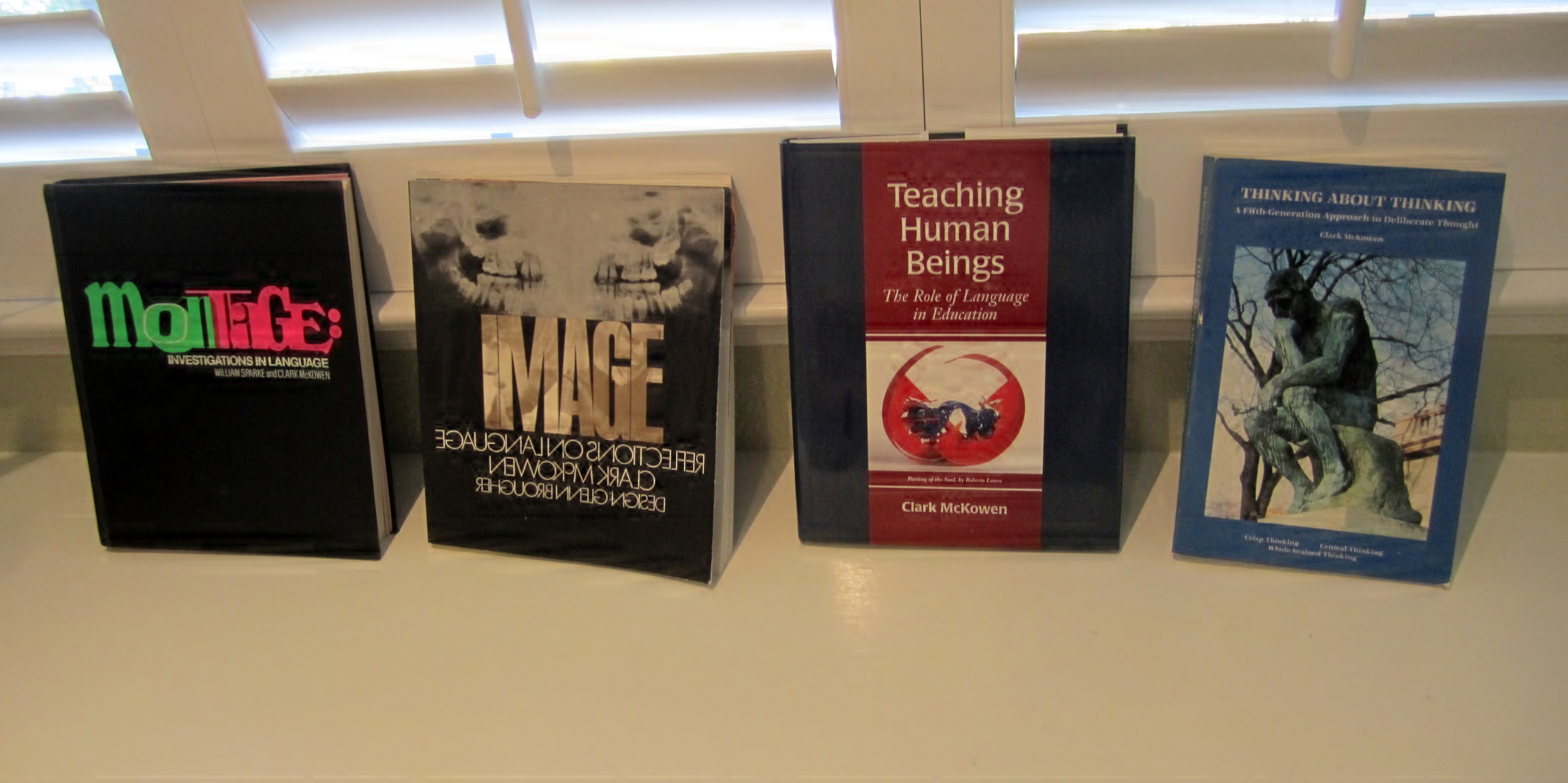
  • Montage, Investigations in Language, which I wrote with William Sparke decades ago, was an interactive book long before the internet. It is full of quotes and stories, and poems and essays and puzzles and photos and science and math and music and grass and sky and air and God knows what. It was designed to engage the mind in thinking about how the world works and how a human being works. If there were any bored readers, I never encountered them.

Montage is all about language too, of course, and how language can imprison the spirit or free it. You can’t read Montage without realizing that prison or the open road is our own choice, to see or to perish, as Chardin rightly said.

  • Image, Reflections on Language traces the emergence of selfhood from before conception to after death. Who were you before your mother conceived you? In the beginning was the Word. What are some productive ways to think about that? How can a spiritual being live in a world of settled ideas? It’s the job of every one of us to disturb settled ideas. How can I take out life insurance without injuring my soul? Where do I live? Is it possible to live where I live? How much of my day is spent on what has happened; how much on what’s up ahead? What’s left?

Image, Reflections on Language does not solicit answers; it simply holds the door open. Reflection on such things enriches our lives, and we don’t care if school keeps or not.

  • Thinking About Thinking sets up explorations into our own minds, using the mind to think about the mind. How does thinking actually work; what is the physics of it, the chemistry, the coding and decoding? Where does metaphor fit in, logic, love? What about the genetic code?

Thinking About Thinking isn’t a how-to book. It’s a playground for messing around with ideas: Whatever you say a thing is, it isn’t. What are some ways to look at that as being true? Whatever you say a thing is, it is. How about some ways that that’s true, too. Can something be true even if it didn’t happen? What are some perspectives from which that idea makes sense? We think by feeling? We feel by thinking? Make both of them true.


If you aren’t smiling, are you really thinking?


There’s so much gained and so much lost in words, in the Word. And there is always Why bother in the first place? Can’t we just memorize the rule book and avoid the pain of figuring things out on our own?

The point of these explorations is not to get answers, which after all are only placebos, but to get a good look at this infinitely large and infinitely small universe. Wonder isn’t an answer. It’s an experience.

  • Teaching Human Beings: The Role of Language in Education is about a way to involve students in this journey no matter what discipline is being investigated. If you are looking at a clump of grass in a biology class or examining the periodic chart in chemistry or the subatomic field in physics or Ode to Joy in music, it’s always about getting a clearer picture of one’s own world, not merely about storing masses of information in the left-hemisphere of the brain. Ask Walt Whitman or Richard Feynman. It’s also about the feeling of wonder that sometimes comes over us on a bus in San Francisco.

Bon Voyage.

Taking Rubbings in the Realms of Gold

IMG_1104

Pouring God into God a la J. D. Salinger


Between Two Infinities

All day long

the Self

takes imprints

from the cosmos

and

nourishes

its

deepest roots.

The Warm Cushion of Your Brain

If the poem below doesn’t make sense right off the bat, you could use it like a saloon puzzle to practice on, like the one in my 11/7/12  post.  The payoff is that tingly sensation that comes over you as you begin to”get” it and the burst of pleasure when you do.   It took me a little while to catch on, but when I did, all sorts of realizations came popping out.  I’m still discovering connections that make me smile, and with a little attention, are astonishing.  I can guarantee you one thing: This poem is as wonderful as you are willing to let it be.

First, look at the poem and see if it makes sense to you.

       Memory

One had a lovely face,

And two or three had charm,
But charm and face were in vain
Because the mountain grass
Cannot but keep the form
Where the mountain hare has lain.

– William Butler Yeats (1865 – 1939)

If the poem makes “sense”, you’re on your way to the Realms of Gold.

If it doesn’t make sense, mess around a while using the surface-features approach [5/29/12], noticing anything that’s there on the surface. Slow-walk it, too. [1/15/13]; let the images wash over your senses.

Or Try Some Connections. 

Where is all the stuff from outside that got past your skin stored up? After all, you’ve accumulated an infinite pile of it, haven’t you?  So where, actually,  do you store her lovely face?  What’s left of their charm when they  have  gone away?  Did you save it up inside yourself somehow?

Generally by the time you are real most of your hair has been rubbed off and your eyes drop out and you get loose in the joints.  But these things don’t matter at all because once you are real you can’t be ugly, except to people who don’t understand.

                                                                –Margery Williams, The Velveteen Rabbit

Or Think About Gravestone Rubbings.

And then have another look at the poem.   If you’d like to take home the actual lettering on some early ancestor’s gravestone, for example, you can make a rubbing.  I did that one summer  in Unity Cemetery just out from Latrobe, Pennsylvania,  where some of my forebears – Hannas, Steeles, Niccolls  –  are buried,  going way back to the late 1770s. (Fred Rogers of Mr. Rogers’ Neighborhood is entombed there, too.)

Rubbing 1

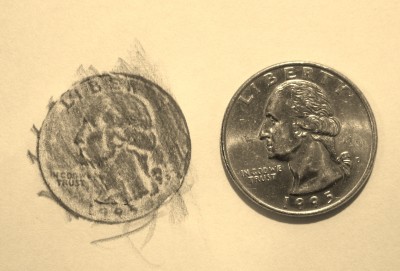
What you do is get a big piece of newsprint, lay it over the gravestone, and rub over it with a charcoal pencil or an oil pastel or chalk – whatever’s handy – like what I did with a silver dollar pictured here.  (That silver dollar  “coincidentally” is dated the year Mary Steiner– my wife Ruth’s mother, who married Joseph Luttner – was born.  Just think, a bit of the physical world in 1886 found its way into my hands and onto this posting and now on to you.)

What your Self is up to, as the day goes on, is taking impressions from of whatever it touches,

and then adding all those to everything that it’s ever encountered,

Like Making Rubbings Off Grave Markers.

There was a child went forth every day,

And the first object he looked upon, that object he became,

And that object became part of him for the day or a certain part of the day,

Or many years and stretching cycles of years.

The early morning lilacs became part of this child,

And the grass and white and red morning glories, and white and red clover, and the song of the phoebe-bird.

– Walt Whitman

You’re busy all day making rubbings off your encounter with wind and rubies.

The little kid sitting on a wall

in Carmel

eating ice cream

leaves an impression

on the warm cushion

of your brain.

It’s that that stays. 

The Zero Point Field

That may sound poetic, but it’s also a description of how particle physics works. I’m talking about what’s down inside your atoms.  Memory (our word for it) finds its way down that far into the warp and woof of things.  Go far enough and our artificial dictionary distinctions between physical and spiritual dissolve.

Your constant capturing of rubbings off the world you move around in – of which you are a part and which is a part of you  – is more like making holograms, those clever projections that physicists have figured out how to create.  Most of us have seen those 3-D  laser projections at science fairs or in the mall that you can walk around and see from all angles and even put your hand into.

Physically, that’s pretty much what your body (a big transceiver like the  satellite dish on your roof ) does.  By way of the sensors all over your body, inside and out, your Self is absorbing the pretty face and the charm in a permanent vessel that can never forget.  If you cut off a bit of the hologram film and run the laser bean through it, it works just as well.  Every little bit is the whole.  What a memory device! That device is you.

Hold to the now, the here, through which a ll future plunges into the past.
– James Joyce, Ulysses

And, what a bonus!, all that went on  before you started walking around the planet is in your DNA, your genetic memory — where all your forebears are and everything thing else too.  Or as Wordsworth put it, “Trailing clouds of glory do we come, from God which is our home.”

Yeats understood this completely. If you “get” his poem “Memory”, you will get it on your senses. You will take a rubbing.  Then you understand particle physics — yes, you do! — and the Zero Point Field – a sea of microscopic vibrations in the space between things

where the little girl is eating her ice cream.

Memory

One had a lovely face,

And two or three had charm,
But charm and face were in vain
Because the mountain grass
Cannot but keep the form
Where the mountain hare has lain.

So, if you really want to remember something for some artificial thing like a school quiz, take a rubbing. Your self will remember.

What’s it all about? 

Well, you have your work cut out for you:

Task: to be where I am.

Even when I’m in this solemn and absurd

role: I am still the place

where creation works on itself.

— “Guard Duty – Tomas Tranströmer


Natural Aids to Memory

[The posts in this website are sequential, like the chapters of a book.  I put the earliest at the top.  If you want to go to the most recent, they’re listed on the left of this page.]

pick-up sticks

Get Your A Book


The Element of Love
 When you love something,  you don’t have to memorize.

For trivia storage, fake it.

In my previous post, before I fell in love, sort of,  with those peaks, what was the process I used to store all those mountain elevations in my mind where I could get at them later?

No one’s really sure how that works.  But we do know some of the things I consciously did.  You’ve probably used them and lots of others yourself from time to time.  Here, I’m just bringing them to your awareness.  Then, if you like, you can use them on purpose.

● Coincidence

● Visualization

● Comparison and Contrast

● Rhythm and Grouping

● Luck

● When I saw that Fuji’s elevation is the same as the number of months and days of the year (12 and 365), ah! the gift of coincidence!  In these realms of gold we live in, coincidence is all over the place, and the more you notice, the fewer things you’ll have to memorize.  It’s done for you.

● When I imagined myself on Adams looking north, “up”, to Rainier and south, “down” to Hood, I was visualizing.

When you’re sitting in a classroom trying to recall these elevations, picture yourself on Adams and your nonconscious will supply all sorts of data you didn’t even realize you were absorbing.  Visualizing is a powerful mnemonic (memorizing) tool.

● While I was messing around, I started associating the mountains with each other.  I even started making a meaningful sketch. Fuji and Adams are about the same. Rainier is about 2,000 feet higher.  Hood is about 1,000 feet lower.  Diablo is about a third.  Everest is two times higher than the highest of the American group

(By the way, using a pencil to trace, to draw, to copy, to connect, gets your motor neurons into the process, too.)

● Meanwhile, I was noticing similarities and differences among these mountain elevations.  That was going on all by itself.  It’s just natural, isn’t it?

Your body is a musical instrument. (You knew that, didn’t you?)

You can feel it acutely sometimes while listening to a concert or while dancing.  For the height of Diablo (3,849), I used rhythm and grouping.  Saying “three thousand eight hundred forty-nine” doesn’t have much going for it. Calling out the digits – “three, eight, four, nine”–  isn’t much better.  But put it in the poetic, musical, mode – “thirty-eight, forty-nine” – and your nonconscious sort of likes that.  Or if you say, “three-eight, four-nine” there’s an nice progression of  digits to notice, and it feels good on the tongue. Melodious.

Luck is a highly underrated participant in each moment of our lives.

It’s there all the time, and we can deliberately make it our ally.  It’s just luck – I guess – that some of the elevations make interesting patterns.  Hood: one, one, two, four, five (11, 245).  Rainier: One, four, four, four, four (14,444).  If we’re alert for such lucky accidents, they seem to pop up everywhere.

Relaxed and Comfortable

You may have noticed other natural mnemonic (memorizing) devices involved in  fooling around with the numbers.  If initial study of the material is treated as play, these natural memory aids will crop up automatically.

The hidden school subject that no one teaches is the art of memorizing, but how much you can remember for some quiz or test is what’s being graded.

In my next post, I’ll pass on some age-old mnemonic tricks.

Memorizing Raw Data

Get Your A Bookimages


The Mind Is a Connecting Organ.

Storing masses of unrelated data is impossible.

If the nonconscious mind doesn’t see relationships, bits of data float  loosely around and can’t be summoned for trivia tests.  The mind doesn’t know where to look.  The bits and pieces probably are in there somewhere, but there’s no way to find all those isolated pieces.

Normally, in our real life – the life outside of school –

We learn the things we love.

Example:

Here’s a way to get  all the senses into the mix .  It’s  from a reflection a student of mine from Puerto Rico wrote after she had spent a day on Mt. Diablo near our college. You can do this with raw data, too.  Just let yourself get the feel of the facts.

Dear McKowen:  I have spent a Sunday up on the mountain of Diablo: Motorcycling up and down, looking at the scenic view. . . .  I brought back all the world on my face — cheeks set aglow by sunset sky, planes, hawks, people, woods, horses, spring flowers and wind.

It could be pinball machines, bluegrass, auto mechanics, the internet, ballet, oceanography.  After sailing around awhile in that sea , we realize we’ve amassed hundreds of terms – without even trying.  They’ve become interwoven in a pattern our nonconscious mind has generously created for us.

Terminology follows interest.  It doesn’t  precede it.

Unfortunately, in way too many school courses, you  are expected to memorize the vocabulary first. That’s backwards.  If students had a chance to fiddle around with a new subject first, they would absorb the language and ideas automatically.

An Example of Natural Memorizing

A colleague of mine, Karl Staubach, had been a forester on Mt. Adams in Washington.  When I was working on the first edition of my college skills book, I decided to give Karl a little memory quiz.

Karl, what’s the height of Mt. Adams?406

Oh, it’s 12,326 feet.

What about Rainier?  (Which you can see from the west side of Mt. Adams)

That’s 14,444

And Mt. Hood?  (visible to the south)

11,245

OK.  How about Fujiyama?

12,365

All right.  Everest, the highest mountain in the world?

It’s 29,002.  It’s really 29,000, but that doesn’t look scientific, so they added 2 feet.

One more.  Mt. Diablo (That’s a mountain near the college where we taught.)

The biggest mud pile in the United States: 3,849

The point is Karl never tried to memorize those elevations.  Knowing them is a by-product of his interest in nature.  No doubt he could tell the elevation of just about every other major mountain in the world.  He knows all sorts of things about trees, too, and spiders and rocks and snakes. But he did not study these things; he would consider such behavior undignified.

This encyclopedic knowledge is the result of fascination, absorption and love.

Fall in love with something, and you won’t need to memorize it.

Before bar codes, the checkers at my supermarket learned hundreds of new prices every week.  A student of mine who served cocktails in a bar could remember the drinks of a dozen people at a table and automatically bring a second round, getting each person’s drink mixed exactly as ordered.  When I was a division chairman, I knew the office numbers of all 37 division members, most of their phone extensions, their schedules, all course numbers and titles. I never tried to memorize any of that information.  Some nonconscious ally of the cocktail server, the checker, and the division chairman knew how to store the data and make it accessible for retrieval.

An Example of Making Raw Data Meaningful

But then you could find yourself in a required course and a teacher who demands that everyone memorize the elevations of six mountains – or 12 or a 100 – without your ever setting foot on any of them, or smelling the air or swimming in an icy mountain lake or seeing paw prints of a cougar on the trail.  That situation is fairly typical of schooling, isn’t it, and it happened to me.

Since I was not very interested in mountains at the time, I thought this would be a good chance to try out a memory strategy, to commit raw data to memory long enough to pass a test, even though I couldn’t care less about the subject.  Here’s a description of how it went – at least for the part of the process I was conscious of.

First, I jotted down the data I needed for the quiz.  Since they meant nothing to me, there was no order.

Adams  12,326

Diablo  3,849

Hood  11,245

Everest  29,002

Fuji   12,365                                Rainier  14,000

I started playing around to see what I might notice, light and easy and not really trying.  Right away I noticed Rainier: 14,444 – a 1 and all those 4s.  And look at Everest: so much higher than any of the others – 29,002, a little over twice as high as Rainier.  (And the 2 at the end seemed so odd that I doubted I would forget it.)

Wait a minute!  Look at Fuji: 12,365, a natural memory device built right into it – 12 and 365, the number and months in a year and the number of days in a year.  (I’ve never forgotten the height of Fuji since I first saw that.  How could I?)

Then I put Fuji and Adams side by side: 12,365 and 12,326 – a 39-foot difference, practically no significance at all.  Look again at Adams: the digit sequence is almost the same as Fuji, and four of the five digits are indeed the same.  Move the 6 to the right and stick in a 2; it boils down to the last two digits, and one unchanged and moved to the right.  Only the 2 is new.  So if I could retrieve Fuji (and who couldn’t?), Adams was duck soup.

Now look at Hood: 11,245, about 1,100 feet less than Adams or Fuji.  That a good look at the digits: 1, 1, and 2, then doubled to 4, plus one for a 5 – 11,245, a nice pattern of digits.

280px-View_of_Mount_Diablo_and_CA_Highway_24_from_Lafayette_HeightsAs you can see, Diablo doesn’t come up to even half the elevation of the least of the others.  It’s about one-third the height of Fuji or Adams.  And look at the digits.  Three-eight, four-nine; 3-8, 4-9.  Take the digits of the 38 and add 1 to each: 49.

Continuing to play, I remembered that I had backpacked on Adams. Looking north I could see Rainier.  Hood could be seen to the south.  You go “up north” and “down south.”  Rainier is “up” and higher.  Hood is “down” and lower.  Rainier is about 2,100 feet higher than Adams.  Hood is about 1,100 feet lower.

Get Involved

Your senses are a powerful aid to connecting up the bits and pieces. 

When you try to recall something, summon where you were, the setting, and all sorts of support you didn’t even realize becomes available.  So, draw pictures, get the feel, whatever senses you can throw into the mix.  Here’s a drawing we put into Get Your A Out of College to show how you could do this.  But there are all sorts of ways to connect up the pieces.  Be my guest.

Rainier


Look what happened.  Merely by playing, messing around, I began building relationships.  Starting with Adams as the kingpin, I was able to retrieve all the other elevations or come close enough to get them all correct on a multiple-guess test.

No one has yet nailed for sure  what the process really is that stored this information for me, but we do know some of the circumstances that accompany such good storage.

Footnote: 

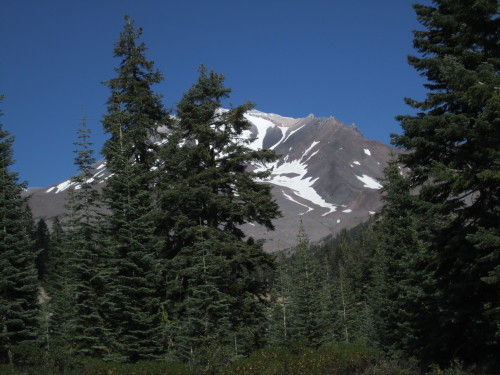
Guess what happened to me while I was storing trivia?  I started getting interested in mountains, especially all those beautiful volcanic mountains that dot the drive from California to Canada. In fact, I’ve spent days and days on some of them and the theme picture for this website is Mt. Shasta. That’s education — so different from schooling!

In my next post I’ll point out some of these natural aids to memory.


Your Powerful Natural Memory

Natural Memory – on Purpose:

OLYMPUS DIGITAL CAMERA

Get Your A Book


●  BE RELAXED

●  MESS AROUND

For the unnatural process of storing and recalling trivia – in classrooms or offices,

USE  INTELLIGENT MNEMONIC STRATEGIES

Why It Works

When you’re stressed out, it’s hard to learn.  Learn the way a little kid does.  It’s child’s play.

Think how you feel when you learn to do things you love.  You feel alive and well, and every bit of energy you use counts.  You’re like a cat, at ease but not passive.  All parts of your body and mind work in harmony.   Be like that when you study, and you’ll learn and remember as easily as a little kid learns language.

So:

● RELAX

Play Music

When you study, play the slow movement of a symphony of  a composer like  Bach, Corelli, Handel, Teleman, Vivaldi – instrumental music preferably.  We’re not sure why this works, but the pace is  at about that of the alpha rhythms of your brain.

Take a Half-Speed Walk

One step per second (described in my 1/15/13 post) until you feel yourself quieted down.

The idea is to give your conscious mind something to do so that it can’t play distracting self-critical tapes.  Your mind and body get a chance to work together harmoniously.  Then, what you’re playfully picking up in the left hemisphere of your brain (for most people) can pass over to the non-conscious right side, which creates a meaningful network of interconnected data.

This is where understanding occurs, but it’s also  a safe, secure place for storing your data, not randomly but in a network of connections.

Tune Up Your Sensorium

A Great Alternative to the Half-Speed Walk:

Sit in a comfortable chair, play the music, shut your eyes and give your attention to your toes.

As soon as you’re aware of your toes and can actually feel them (without moving them), move your attention back along your feet, your heels, your ankles, and so on.

Once you fully sense your feet, move on, up your legs, up your torso, your arms, the back of your head, until the senses of your whole body are wakened.

Your body will feel tingly all over, and any stress will have drained away.

MAKE MUSIC AND RELAXATION A HABIT.

●  MESS AROUND

If you want to store up stuff for later recall, your mind has to find a framework or create one.

Beginning at the beginning is going blindly into the wilderness without a map.  Without an overview, any effort to memorize is futile.  The circuitry has to be set up.  You need a format.

Messing around is another name for formatting.

The rest is pretty much the mess-around strategy I described in my  11/11/12 post for reading, browse, focus, absorb, reinforce.

Play your music and use a relaxation exercise.  

You should feel good – comfortable and awake but not tense, no sense of pressure.  Then look over the job.  Do a pass through.  It doesn’t matter where you start.  You can move in any direction and pause anywhere, for as long as you like.  Let your curiosity guide you.  When you feel saturated, take a break.

When you’re ready, come back and do another pass through the whole thing again.

Keep messing around in this fashion until you become aware of the pattern.
Meaning will begin to emerge and take form.

Keep playing with the material. 

At some point you will become aware of a pattern taking shape.  Gradually you will flesh out your understanding.

Don’t try to memorize anything until you can say, “Yes.  I really do understand this.”

If you have no experience with the subject at all, you might feel nervous and inadequate.  (little kids would never feel like that, but you may well have suffered through lots of judgmental classrooms over the years that you haven’t got out of your system yet.) So go away for a while.  Your nonconscious will be working on it in the meantime.

Keep coming back.

Suddenly It Makes Sense

Seemingly on their own, things that appeared hopelessly vague will suddenly start making sense.  Just let it happen.  There can be a number of passes through, some long, some short, some superficial, some intense.

Interact.

Sometimes you may want to interact.  Go right ahead.

Try problems, draw pictures, fool around with possibilities.

The total time spent will be no longer than that of typical, fruitless methods, but the results will be amazing.  You will have shifted the learning (and storage of data) to your brilliant nonconscious mind, which does this sort of thing effortlessly.

Your conscious and nonconscious programs will be working in harmony, and you will actually feel refreshed.

Bottom Line:

Browse.  Browse.  Browse.

●  STORE THE TRIVIA 

When you feel thoroughly comfortable and familiar with the material and confident that you do understand, then see if there is anything left to memorize.  You will find there is hardly anything left to worry about.  Without even trying, you will have done most of the memorizing, and the material will be lodged far more permanently in your mind than it would have been with conventional study methods.

In my next post, I’ll describe a couple of ways people have figured out for storing and recalling trivia.

The Realms of Gold Saloon

Not Found in Headlines

It is difficult

            to get the news from poems

                           yet men die miserably every day

                                                          for lack

of what is found there.

                            — William Carlos Williams, from “Asphodel, That Greeny Flower”

OLYMPUS DIGITAL CAMERA


If you are looking at this website instead of today’s headlines, odds are you’ve caught a glimpse of what lies beyond the headlines and would like another glimpse.  Some people, people like Rumi and William Blake and Emily Dickinson, live in the realms of gold all the time. Here’s a poem Emily Dickinson wrote describing her experience there.  If you don’t see the gold right away, try the surface-features approach a while (described in my posts of 2/12/13, 2/4/13 and 5/29/12) .  That should ramp up the lighting.

I taste a liquor never brewed

I taste a liquor never brewed —
From Tankards scooped in Pearl —
Not all the Vats upon the Rhine
Yield such an Alcohol!

Inebriate of Air — am I —
And Debauchee of Dew —
Reeling — thro endless summer days —
From inns of Molten Blue —

When “Landlords” turn the drunken Bee
Out of the Foxglove’s door —
When Butterflies — renounce their “drams” —
I shall but drink the more!

Till Seraphs swing their snowy Hats —
And Saints — to windows run —
To see the little Tippler
Leaning against the — Sun —

Clark McKowen — On Zen Days

Clark McKowen

Clark McKowen


A Rich, Manifold Life —

. . . brought close to the eye


This website is sort of a workshop for getting into the inner and outer reaches of human experience.   In a way,

It’s about getting all I can out of my cornflakes. 

It’s a reminder that the smell of shoe polish has infinite dimensions —  if I’m willing to think about it.  And it’s a lot more fun, at least for me, to enjoy as much of my moments as I can while they are happening.

  • Realms of Gold is about the split between the perceived world — what we ordinarily see — and what we know lies beyond perception.

So if you want to get at the whole thing,  it can’t be just poetry or stories, and it can’t just  be about all those numbers involved in nuclear physics and DNA. The smell of shoe polish  involves applied linguistics, metaphor, semantics, and the arts – in fact, all the disciplines mixed together. It has to includes  physics, biology, and mathematics.

It includes the world within the skull of each person engaged in these explorations.

Various Tangents

I  Iike to mess around with various tangents of whatever’s in front of my eye just now — just to be a bit more awake.  For me, it enriches my day if I’m more in tune with what’s happening — while it’s happening.  I may as well say it up front: These posts always come back to the nutty idea that

Everything is everything.

So, if everything is everything, then chimpanzees are not some isolated, if fascinating, aspect of our planet.  They are all about me — and you.  We may not be very conscious of it, but we humans are always trying to see how we fit into everything.

  • I’m always trying to get a good look at our situation here in the universe. 

Things seem to come alive more when I do that.

 The Shipping News

Clark’s Boat —

Sailing at 10 AM

from Alameda

into

some region

of

the Sea of Intelligence


Memorizing: The Mess-Around Strategy

Sandbox Learning

Get Your A Book

Don’t try to memorize anything up front.  That’s not natural.  It is natural to start out by fiddling around with whatever you’re trying to figure out.

While you’re playing, things will start to click and to fall into a pattern that makes sense.


The mind uses patterns to connect bits and pieces into meaning.

Keep on playing and at some point you will say, “I see.”  And a bit later, “I really do understand this.”

Iimagesf you browse through now, you will find there is hardly anything left to memorize.  The data have been magically caught in your memory net, and the whole process will actually have been fun.

What’s left is for your boss or teacher – whatever details they may want you to recall.

Here’s the Mess-Around-Method for Memorizing in a nutshell:


Play around until you understand.

Check for leftovers.

Digest the leftovers.


Too Simple?

That’s the process you’ve been using all your life – effortlessly.


You pay attention; you are never passive.


It’s a matter of allowing your nature to guide you and trusting that it does the work.

It always has.

Use the force, Luke

Fire-Walking the Realms of Gold

Splitting the Atom – Lessons in Walking

Fire

Parting of the Soul


Parting of the Soul — Roberto Lauro


Slow-Walking the Shore Trail,

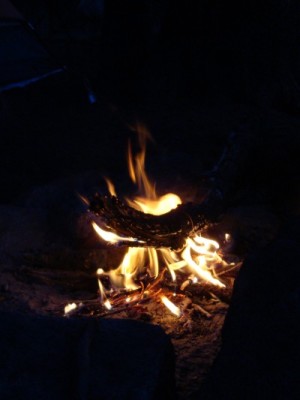
Soft breeze on your face, the magic City across the Bay, you may not notice you’ve been fire-walking the sea of intelligence.  Reality, after all, is a compelling illusion. But if you would like a glimpse of the fire beneath your feet and the furnace within the atoms of your body, here’s how fire-walkers do it:

You have to spend the day preparing the fire and tending the coals.  You have to sit around chatting, eating, raking the ash off, watching twilight fall.  After a while you quiet down.  Your concept of fire releases its grip and you relax.  Thinking back, you  realize the intensity of the fire is in you, not the coals. That’s  your idea.  That is how a fire-walker  friend described his experience to me, but it’s the story all artists tell ‒ aerialists (like Philippe Petit who in 1974  illegally strung a wire between the tops of the World Trade towers and strolled across.), sculptors, physicists, philosophers, plumbers, and roshis.

Things quiet down,

opinion loses it’s grip,

then you can do back flips,

look into the atom. 

Then you see.

✳✳✳✳✳✳✳

Gold-Vermillion

Maybe you’ll see a hawk with the intensity that  Sidney Field did one afternoon in  the Hollywood hills (described in my post of   January 29, 2013) or the way Gerard Manly Hopkins saw a windhover (kestrel, falcon) on an illuminated morning in 1918 and thought of the fire that breaks from Christ, “a billion times told lovelier.”

windhover

The Windhover

To Christ our Lord

I CAUGHT this morning morning’s minion, king-    
  dom of daylight’s dauphin, dapple-dawn-drawn Falcon, in his riding    
  Of the rolling level underneath him steady air, and striding    
High there, how he rung upon the rein of a wimpling wing    
In his ecstasy! then off, off forth on swing,            
  As a skate’s heel sweeps smooth on a bow-bend: the hurl and gliding    
  Rebuffed the big wind. My heart in hiding    
Stirred for a bird,—the achieve of; the mastery of the thing!    
 
Brute beauty and valour and act, oh, air, pride, plume, here    
  Buckle! AND the fire that breaks from thee then, a billion           
Times told lovelier, more dangerous, O my chevalier!    
 
  No wonder of it: shéer plód makes plough down sillion    
Shine, and blue-bleak embers, ah my dear,    
  Fall, gall themselves, and gash gold-vermillion.

Memory: What Schools Really Test

Remembering, Recalling — And Good Grades

Get Your A Book
I will describe in later  posts ways to retrieve information that are natural and effective.  But first here are some things to think about.

Do you believe intelligence, talent, hard work, and honesty are what get you good grades? Your experience tells you otherwise.  Some schools may value thinking and learning, but

What’s tested is how good you are at remembering things.

It takes time and involvement and care to find out how well students are truly coming along, but those ways take time and involvement and care. It’s lots easier just to test for a bunch of data.  (If a teacher really wanted to know how a student was doing in chemistry, he could ask her.)

Most teachers test for facts.

And of course if you want to recall raw facts, you will need some memory strategies. When was the last time anyone bothered to show you how to get good at that?

How the Game Is Rigged

What’s tested and graded is skill in dredging up information –  remembering, recalling.

If schools actually did emphasize understanding, the facts would fall naturally into meaning networks and would be easy to recall.  That’s how you learned all the stuff you have stored in your nervous system – no sweat.  But most teachers expect you to remember facts – the vocabulary of the subject mostly – and never bother to show you how.  Of course, if all students were good at the memory game, it would spoil the ranking system; everyone would get high scores.

Dutiful students spend most of their time trying to remember and usually doing a rotten job of it.  That’s because, although ordinary brains are expert at learning and remembering, storing raw data is unnatural.  It can be done and easily, but it requires conscious awareness of how memory works.  Most students have had little or no education on memorizing – even though it’s more vital to school success than anything else.  Yet,

Even a little attention to memory processes gives you a powerful advantage.

Here’s one rotten technique you can toss out right away: Passive repetition.

Saying something over and over again numbs the mind.  The results are disappointing and depressing .  Relaxing over late-night TV would prepare you better for a test than two hours of passive repetition.

All You Really Need to Know About Memorizing

You have an excellent memory, and you use it effectively most of the time.
If you have trouble with a school subject, you are most likely trying to master it in a way that’s unnatural to you.OLYMPUS DIGITAL CAMERA

Natural memory works well only in a warm and friendly environment.  Fear or pride or force will shut down the process.

Remind yourself of what really works for you, use it when working on school subjects, and you will have the same success that enables you to function so well out of school.  The more conscious you are of how you actually do learn and the more you trust yourself to do the right thing, the more fun you will have with school subjects and the easier it will be to master them.

Your methods are uniquely your own, but they are a variation of the Mess-Around method that I will describe in my next post.